Running a marathon
I decided to run a marathon. I don't really know why. It is one of those projects I have had on my mind, on and off, over the years. So I guess it was more a question of when than why. Well, I was at a bar in Denmark in December, 2025, having had a beer or two, maybe three, when I signed up for the Amsterdam Marathon 2026. My reasoning at the time was that I could easily give my ticket to somebody else, should they be more inclined than me to run the marathon.
There is much to say about running, but I do not have much to say that has not already been said. I read What I Talk About When I Talk About Running by Haruki Murakami more than ten years ago and it is still a book I will recommend, even if you are not into running. I do not have any novel observations on running or any meaningful advice on how to run a marathon, let alone half a marathon. In this post, I will briefly outline a few thoughts on my experience with the Amsterdam Marathon 2026 while still relatively fresh in memory.
I like running. It is a simple, healthy, cheap hobby that gets me outside when I feel like it. You move forward until you are done, and then you hopefully feel good without any physical pain. There is no competitive aspect to my running. I am not behind. I am not on a schedule. I do not care about my time on Strava. I do not even need to trust the process. There is no process. I am not running to get a good time, but to have a good time. It is all vibes. In other words, I did not decide to run a marathon to run it fast, only to run it at all.
The marathon took place on Sunday, October 18. I took Friday and Monday off from work to give myself more time to relax before and after the marathon. I went for a final 16k on Tuesday, October 13, and then it was basically all about waiting, relaxing, and eating some carbs along the way. Friday, I went and picked up my bib number (strong exit-through-the-gift-shop vibes at the conference centre on Europaplein), Saturday evening I went to Spaghetteria in De Pijp for carbs, and on a cold, rainy Sunday morning I went by bike to Stadionplein to finally run the marathon.
On the weekend of the marathon, I also watched the Dutch documentary De marathonloper. It follows a series of marathon runners as well as the people making the marathon happen on the day of the Amsterdam Marathon 2024. I would not necessarily recommend the documentary, but I found it engaging, and it gave me a sense of what to expect on the day. It also makes you reflect upon and appreciate all the behind-the-scenes work going into the marathon.
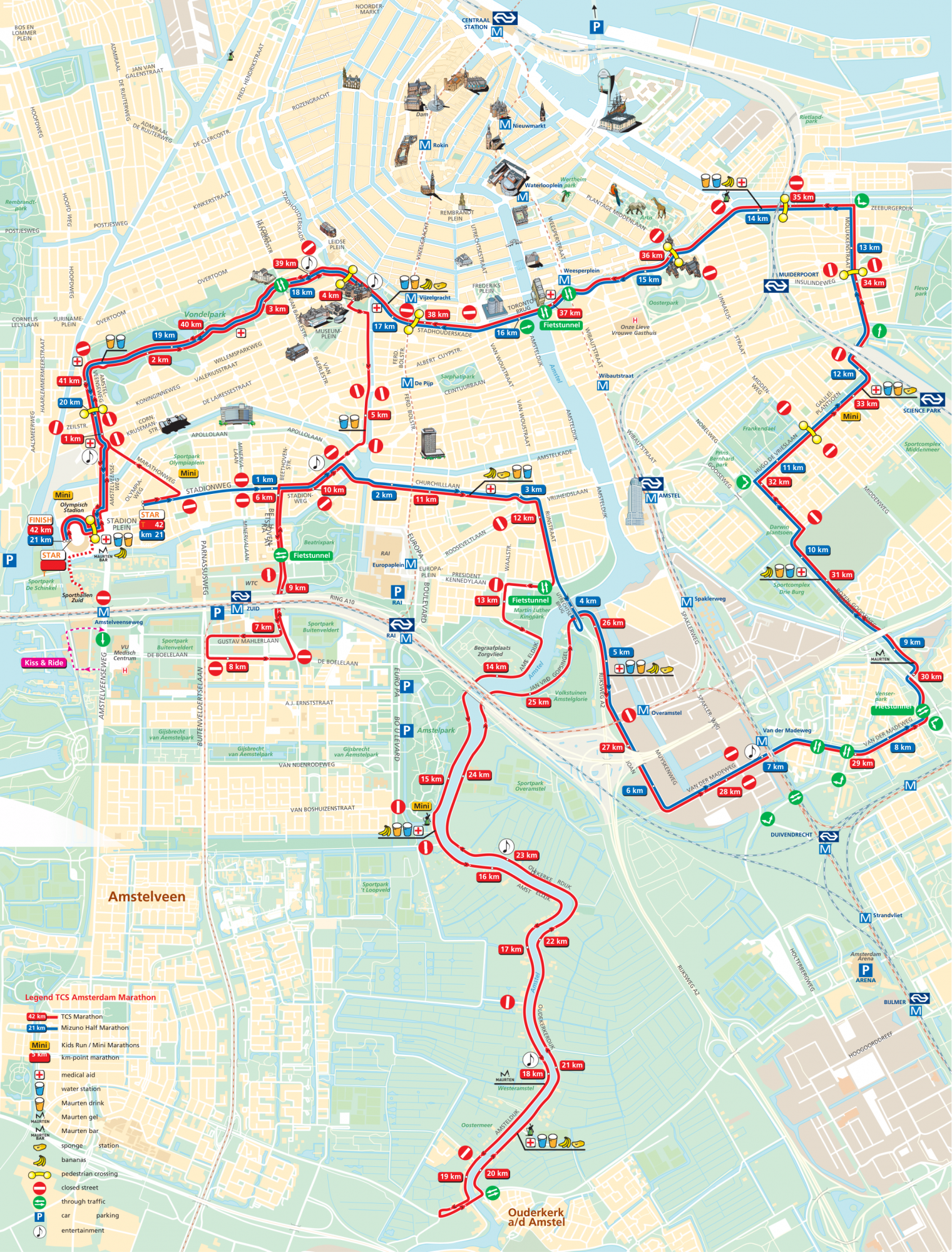
The map below shows the course for the 2026 marathon. From what I can understand, the course is similar to previous years. The primary thing to notice is that the marathon did not, for good reasons, bring you into the old Amsterdam. I would split the marathon into five parts. First, the beginning from the Olympic Stadium through Vondelpark to Museumplein. Those first five kilometres are fun. Second, the run in Zuidas and the south of Amsterdam until Amsteldijk (slightly overrated and most likely included just because this part of Amsterdam is dead anyway on a Sunday morning). Third, and this is my favourite part of the route, from around 13 km to 26 km, where you are running next to the Amstel. Fourth, Amsterdam Oost (by far the most boring part of the marathon). Fifth, the journey back to the Olympic Stadium, again via Vondelpark. It is an overall good, flat route.
I am no stranger to parts of this course. Since September 28, 2024, I have run 80 times in total. Most of these runs have been in Amsterdam, and most of them next to the Amstel. In 2026, I have run once per week on average. The marathon was the 42nd time I ran this year, and it took place in week 42. I guess 42 really is the answer to at least some questions in life. However, this is generally not recommended in order to prepare for a marathon. On the contrary, you should run and prepare a lot more than I did, and I ran a marathon with a significantly higher injury risk. For that reason, one of my primary goals of running the marathon, in addition to completing it, was to not get injured.
So the primary thing I did to complete the marathon - in addition to running, on average, every week - was to follow some generic advice, e.g., from this blog post: run slower, prioritise recovery (e.g., get a lot of sleep), and do strength training. For strength training, I could have done more (from August until marathon day I only managed to hit the gym twice). I did not drink any alcohol between my birthday and marathon day, which was most likely a good idea.
I did consider getting new running shoes, but I still like my old Nike shoes. I did consider a running vest but ultimately opted for a belt to hold my phone and keys. I brought a few gels and some water along for the marathon, and there was a rich supply of water, energy drinks, bananas, and gels on the route. As I have gotten used to running 16k without bringing any water along, it made the marathon feel relatively easy to get through.
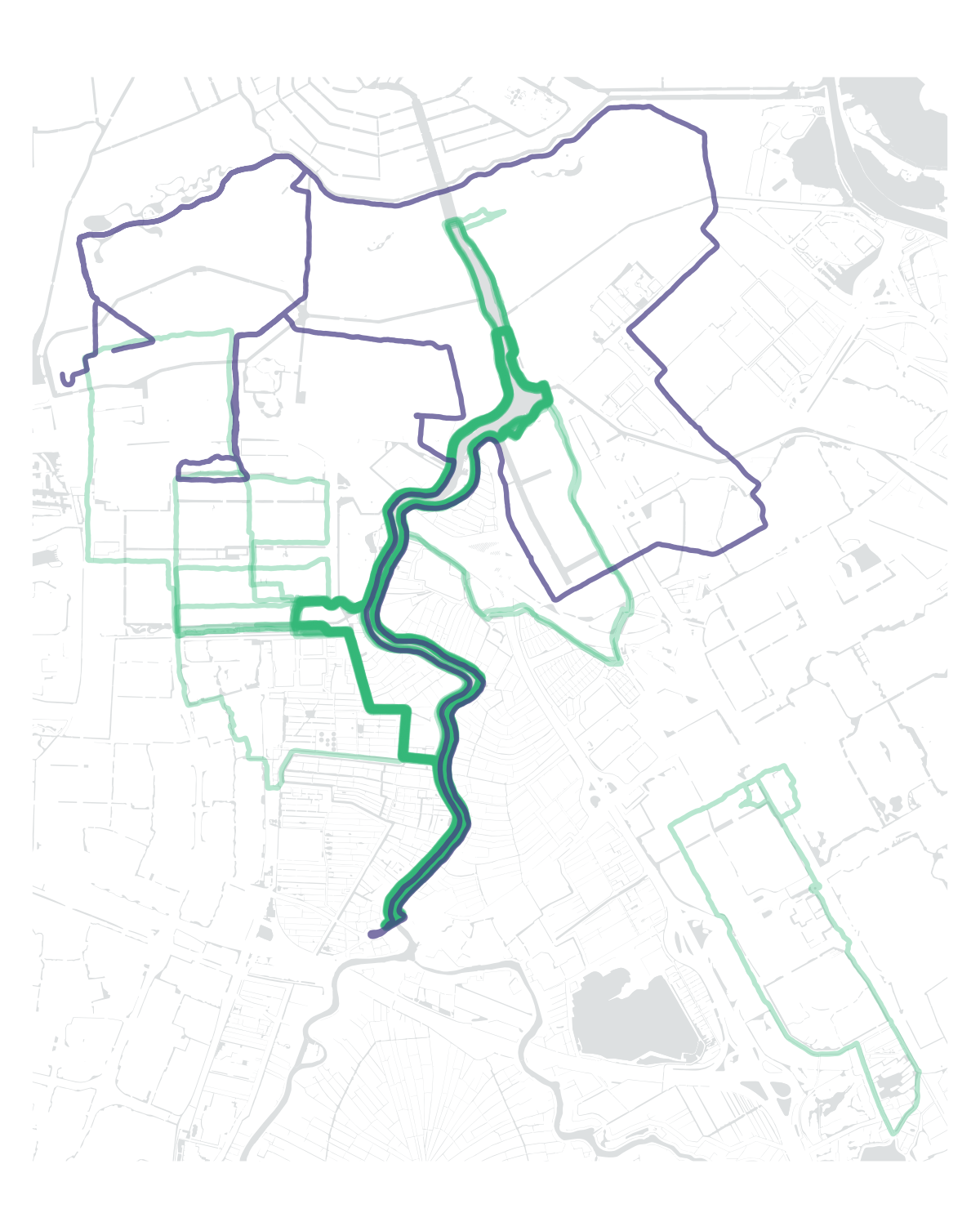
I exported and analysed my runs from Strava. I focused on the 39 runs in Amsterdam in 2026 (three of my runs from this year have been outside of Amsterdam). In the figure below, I plot all 39 runs with the marathon being the purple line. As you can see, most of my runs have followed the same 16k route along the Amstel, which overlaps with a significant part of the marathon course. Interestingly, with my 39 runs this year, I had covered more than 35% of the marathon course.
Most of the 16k runs I have done this year have been at a pace between 5:00 min/km and 5:30 min/km. The fact that you have six hours to complete the marathon means that I could even finish the marathon at a pace of 8:30 min/km. This makes me believe that, if you can withstand injuries, you should be able to train for and be able to run a marathon. It can sound like a humblebrag, but I truly do not believe there is anything special or extraordinary about running a marathon. You settle for a pace and you get it done.
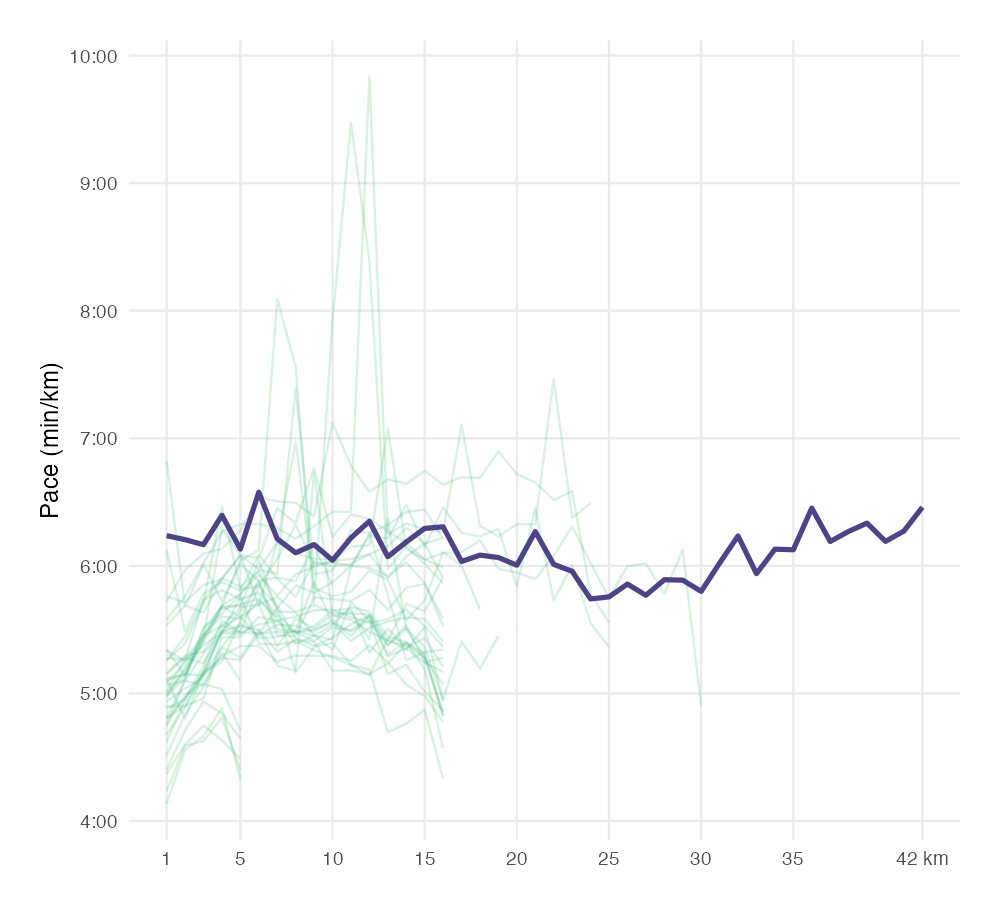
In the figure below, I show the pace for each of my runs this year in Amsterdam, again with emphasis on my marathon run in purple. There are three things worth noticing here. First, and unsurprisingly, the shorter my runs, the better the pace (my fastest runs are of course my 5k runs). Second, I managed to keep a relatively stable pace throughout the marathon with a lot of the kilometres being completed with a pace between 6:00 min/km and 6:15 min/km. Third, I concluded around the 21k mark that I could most likely run a bit faster and still complete the thing, so I ran the next kilometres with a pace of sub-6:00.
There is always a risk when deciding to run faster. I saw a new study by Seffrin et al. (2026) suggesting that men are twice as likely to "hit the wall" than women. I am not sure what to make of this finding. I can easily imagine that potential "hit the wall" men are more likely to sign up for a marathon in the first place compared to potential "hit the wall" women. And the 'net finish time' used to determine performance categories should be related to hitting the wall, making it difficult to interpret these findings. In any case, I have been thinking quite a bit about the risk of simply not being able to continue running, but it luckily never got to that point.
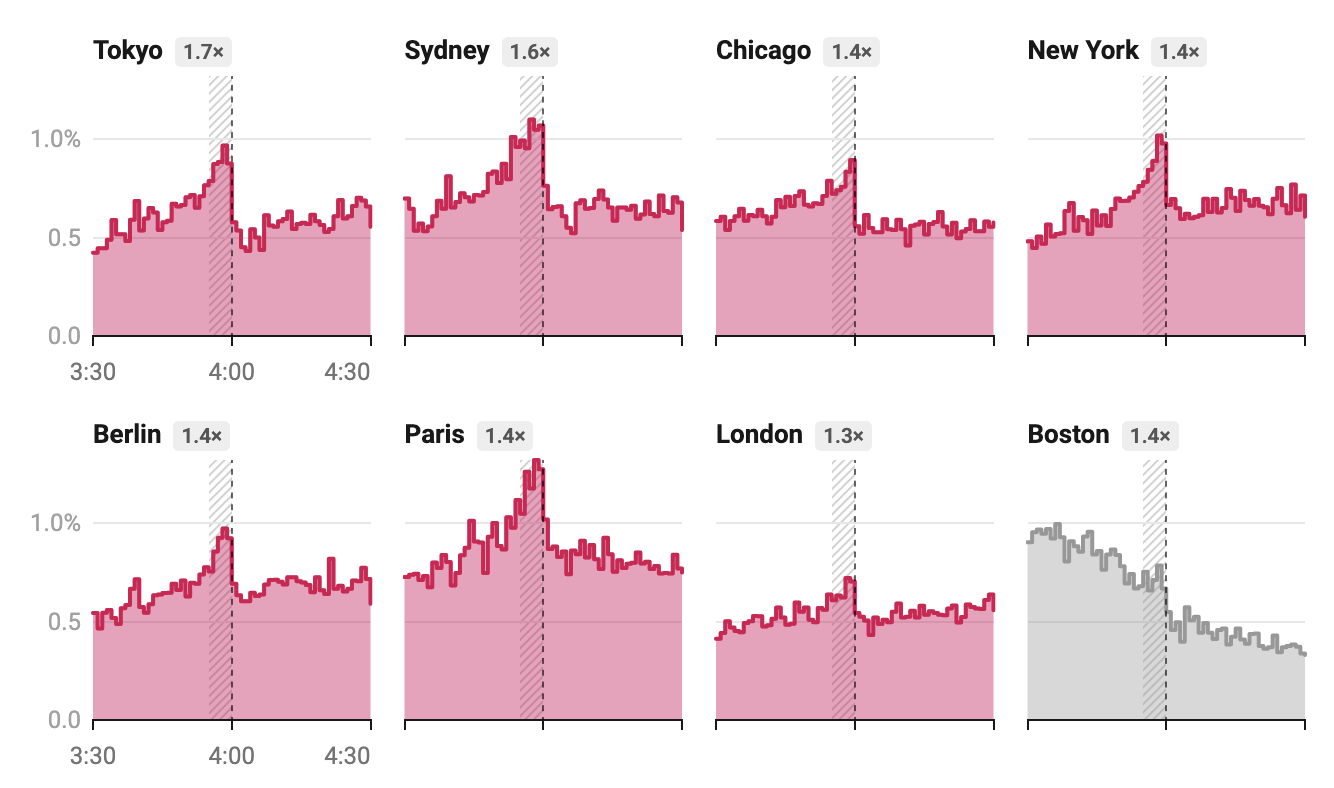
While I said that I did not care about my final marathon time, I could not stop thinking about it as I got closer to the finish line. That is, it seemed very realistic that I would reach a time below 4 hours and 30 minutes, so I decided that it would be the goal. There is evidence that marathon runners are more likely to complete a marathon just below 4 hours (than just above 4 hours) (e.g., Allen et al. 2017). See, for example, the figure below from Datawrapper. (The data is available here.) I cannot rule out, should I decide to run a marathon again, that I would consider a specific time-based goal.
I had a few other concerns for the day. First, the weather. I ran during the summer, some days in ~30 degrees Celsius, and I was hoping for a bit of sun on the day. My biggest worry was too much rain, and while it rained a bit, it was generally fine. Second, the thought of not having to go to the toilet for up to five hours seemed crazy. Luckily, it turned out to not be an issue at all and I did not have to make a single stop (and I was positively surprised to see a lot of toilets along the route). Third, being bored. I was ready to listen to various things during my run to kill time. My plan was to have ~14k of podcast, ~14k of audiobook, and ~14k of music, but I ended up not listening to anything but the ambience of Amsterdam.
There were a lot of people out on the route supporting their friends and family, which was great to see. Amsterdam is also home to a lot of DJs, and there was a lot of music and entertainment along the course. This also contributed to me not feeling bored for most of the time. There were also a lot of signs to read and think about (the best one I saw said "Did therapy not work?").
I was also surprised by all the photographers out on the course. That is great for the people who want to have a lot of pictures to remember the marathon from. Below is part of one of the images I can see was taken of me.
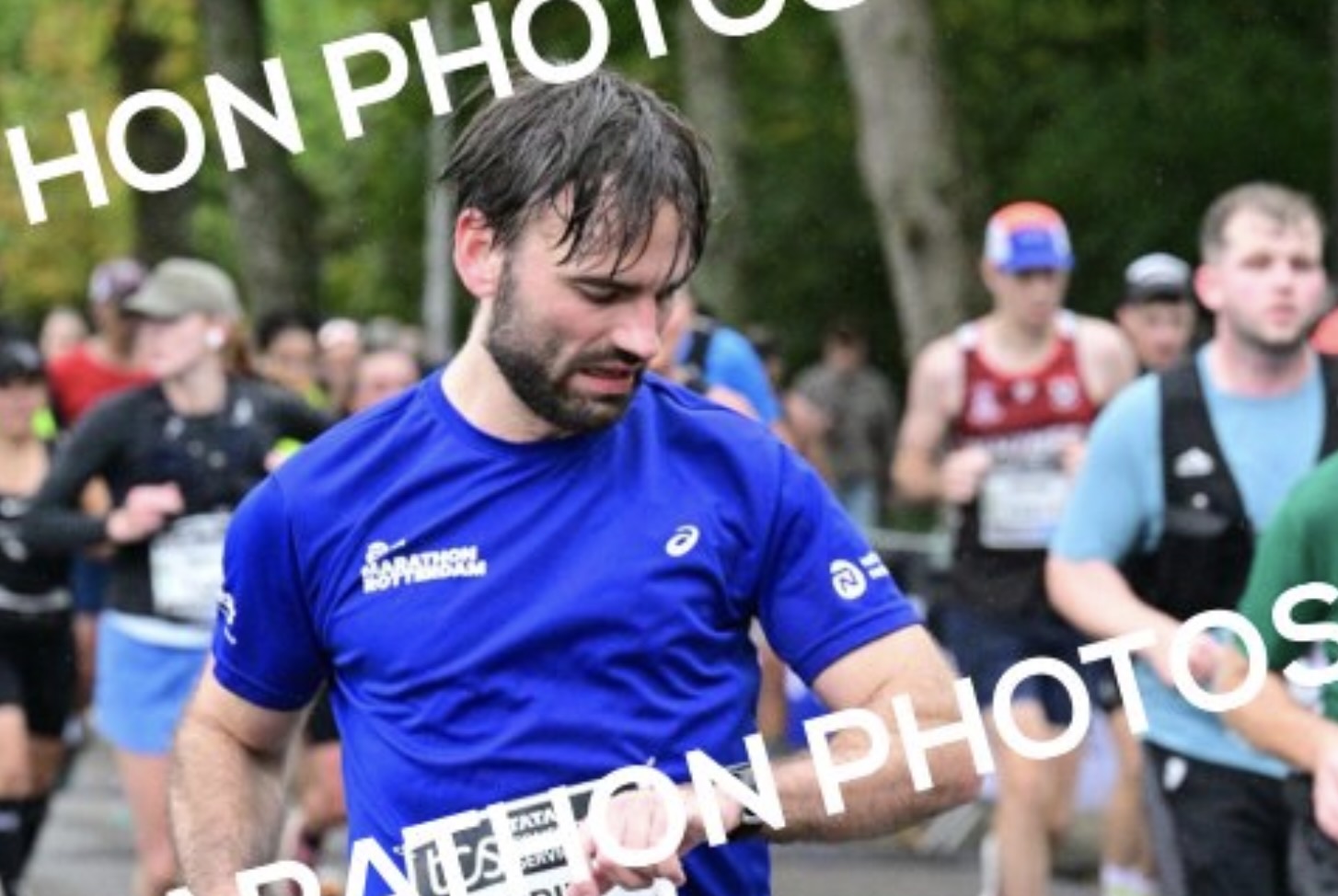
There are at least three things you can tell from the picture. First, I do not want to pay for any photos of myself, hence the watermark. It is great that there is a market for this, but I would not mind if no picture were taken at all. Second, as this was towards the end, and I should be enjoying Vondelpark and the fact I was practically done, I was looking at my watch more than anything else. I was slightly annoyed by the fact that I had to run closer to 43k than 42k to complete the marathon, but I am being told that is normal. Third, my t-shirt was from the Rotterdam Marathon (one of the runs I did this year was a 10k in Rotterdam). Should I decide to run a marathon in the future, the logical implication is that I will most likely be running it in my Amsterdam Marathon 2026 t-shirt.
Once the marathon was over, I just wanted to go home, relax, and have a tea. It was great not being alone straight after, being able to talk about the day, get some warm clothes on, and feel happy that it was over and went well. I consumed a lot of water and tea the rest of the day (and a Vrijwit 0.5% from Brouwerij ’t IJ), and my body appreciated it all. The day after I went for a walk and I felt fine. No pain. My legs felt a bit sore in the following days, but nothing significant.
I have not been running since the marathon, and I doubt I will be running much for the rest of the year, if at all. I don't like running in the dark, or when it is too cold. Accordingly, I am happy to spend time on other non-running activities (going more to the gym, bouldering, trying out yoga, etc.). As is usually the case, most of the obstacles I have to deal with are created by myself, and I just have to figure out what is next.